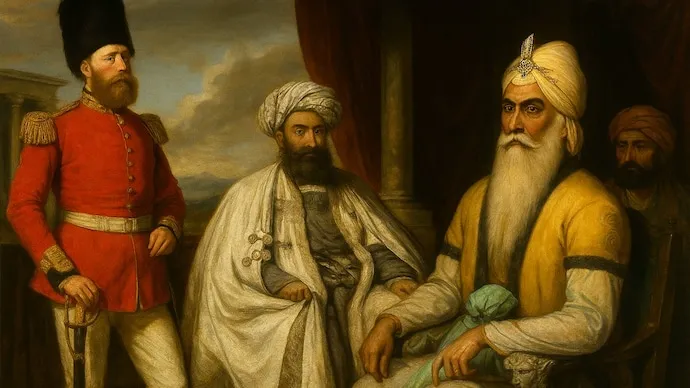
Sher-e-Punjab, as he is famously known in history, Maharaja Ranjit Singh ruled a territory that stretched from Khyber Pakhtunkhwa in present-day Pakistan to Tibet in the east. The influence of the Sikh ruler and founder of the Sikh Empire was so great in this area that the British never attempted to invade the Sikh empire during his reign, and the Afghans dared not cross the Indus River.
Even in its later years, Maharaja Singh managed to install a regime in Afghanistan by asserting political control. The British were at the play of it, who moved into Afghanistan from the south while the Khalsa army moved from east.
At that time, the British had to rely on Sikh support. In 1838, Maharaja Ranjit Singh witnessed a victory parade on the streets of Kabul -- a historic moment in itself.
As Khushwant Singh writes in his book Ranjit Singh: “In pursuance of that agreement, the British Army of the Indus entered Afghanistan from the south, while Ranjit Singh’s troops went through the Khyber Pass and took part in the victory parade in Kabul.”
Khushwant Singh writes, "Maharaja Ranjit Singh made it clear to the British that the Russians were trying to befriend him. The King of Nepal was in constant touch with him and there were also rumours that the Maratha chief and Nizam Hyderabad had also sent their representatives to meet him."
Born in 1780, Ranjit Singh was not good-looking. He lost his left eye in childhood due to smallpox and had deep scars on his face.

"Ranjit Singh was not more than 5 feet 3 inches tall. His shoulders were broad, his head was large and seemed sunken in his shoulders," writes Alexander Burns in A Voyage up the Indus to Lahore and a Journey to Kabul. Read More
This article is referenced from
https://www.indiatoday.in/
Views: 4.8k